The starting document for the design of emergency lighting is the standard HRN EN 1838:2025, Lighting applications — Emergency lighting. This standard specifies lighting requirements for emergency lighting and standby lighting systems installed in rooms or locations where such systems are needed. It generally applies to locations accessible to the public or to workers.
The purpose of emergency escape lighting is to provide illumination rapidly, automatically and for the required duration in a given area when the normal lighting power supply fails; to illuminate escape routes and other routes enabling safe evacuation; to illuminate fire alarm and fire-fighting equipment; and to allow hazardous operations to be shut down safely (high-risk task areas).
Emergency lighting is not intended solely for fires or activation by a fire alarm control panel: it is needed whenever an unforeseen supply failure occurs, including failures of individual distribution boards rather than only a complete power outage.
Emergency escape lighting is not intended to enable work to continue in high-risk task areas.
Emergency lighting is intended for use when the normal lighting power supply fails and is therefore supplied from a source independent of the one powering normal lighting. For the purposes of this Handbook, emergency lighting is a generic term encompassing several specific forms, as shown in Figure 2.
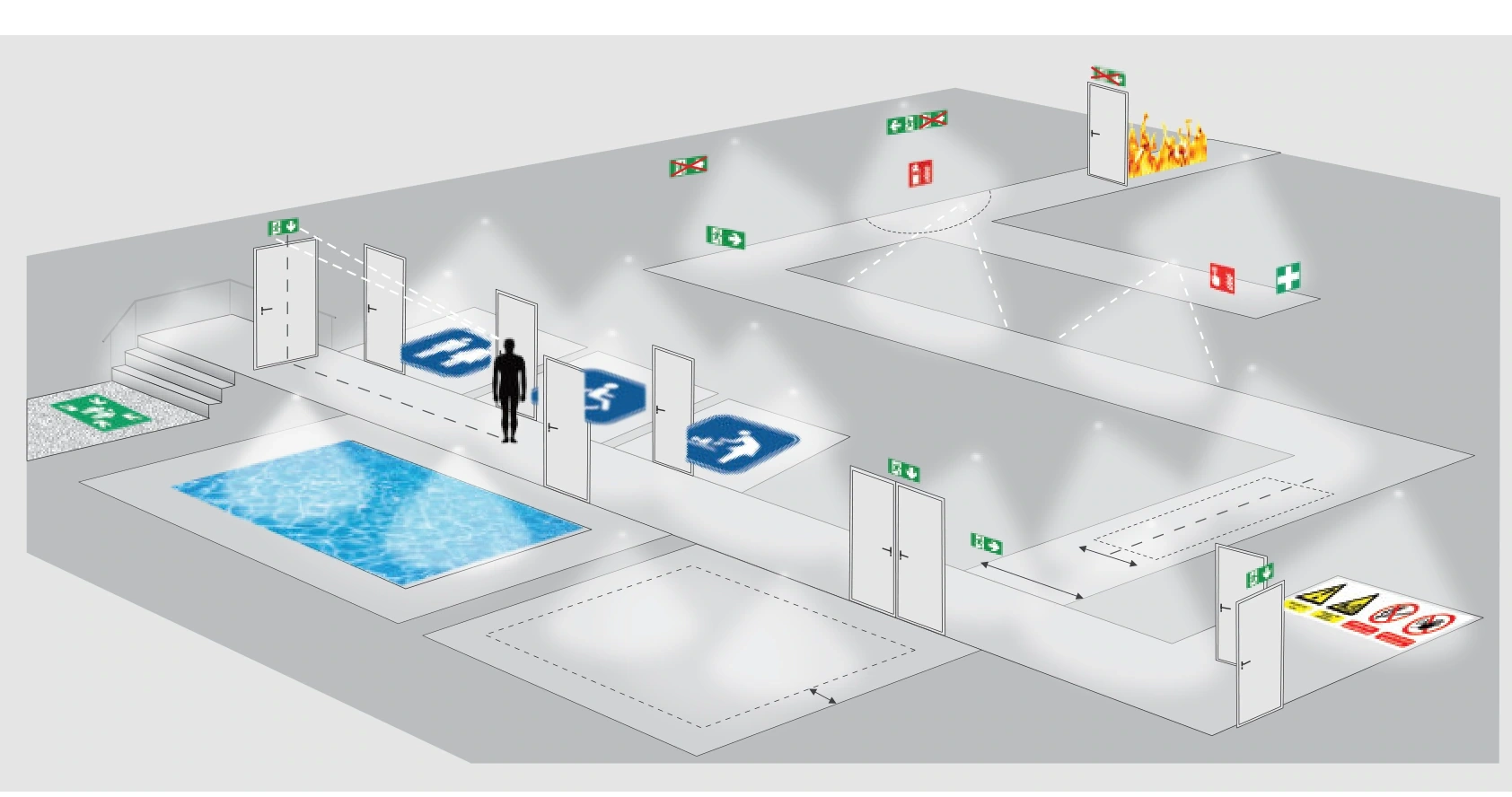 E :1 lxmin> 0,5 lx>5 lx> 0,5 lx5 lx5 lx5 lx> 0,5 lx> 1 lx0.5 m2 mr = 2 m1 mE :40 lxmaxhlE : E< 40:1maxminsrminE : 15 lx < 10:1E > 15 lx> 5 lx> 1 lx> 8 m²
Types of emergency and escape lighting
Emergency lighting
(emergency lighting)
Lighting that permits the safe evacuation of people from a building in the event of a failure of mains power to the normal lighting system and also allows high-risk activities in hazardous areas to be terminated safely. It is divided into standby lighting and emergency escape lighting.
Emergency escape lighting
(emergency escape lighting)
The part of emergency lighting whose function is to provide direction and sufficient illumination so that people can evacuate safely from the building or reach a safe place within it. It also enables high-risk activities to be stopped safely so as to prevent additional accidents.
Standby lighting
(standby lighting)
The part of emergency lighting that allows activities to continue without interruption when mains power fails (for example, a basketball game or a performance) by switching to backup power sources (generators, UPS, etc.). Under HRN EN 1838, standby lighting is classed as emergency lighting, but it does not perform a safety function and is not mandatory by law.
Escape route lighting
(escape route lighting)
The part of emergency escape lighting that indicates the correct direction of travel towards the building exit using safety signs (pictograms), provides the necessary illuminance of escape routes and allows fire-fighting and safety equipment to be found and used easily. It includes escape route lighting, illuminated safety signs and low-mounted directional markers.
Adaptive (dynamic) emergency escape lighting
(adaptive emergency escape lighting system (AEELS))
Adaptive lighting can supplement conventional emergency escape lighting and increase its effectiveness in emergencies. Such a system includes internally illuminated safety signs (pictograms) that can dynamically change the displayed information to indicate alternative escape routes or warn that a particular route is closed or temporarily unavailable.
Open area (anti-panic) lighting
(open area lighting)
Emergency lighting for large open areas is intended to reduce the likelihood of panic by providing adequate illumination and guiding people towards an escape route.
High-risk task area lighting
(high-risk task area lighting)
The part of emergency lighting that enables the safe evacuation of people engaged in potentially hazardous processes and the termination of high-risk activities in hazardous areas, to prevent further accidents.